
I am a first-year PhD student in the Computer Engineering Lab (CEL) at the University of Sydney, advised by Prof. Philip Leong. My research interests include computer architecture and FPGAs, with a focus on LLM accelerators and agentic EDA.
Before coming to USYD, I spent a wonderful time in Canberra for Master of Computing (Advanced) degree at the Australian National University from 2024 to 2025. I received a Bachelor's degree in Computer Science and Technology from Beijing Institute of Technology in 2022.
I am open to internship opportunities, collaborative research, technical discussions, and knowledge-sharing opportunities in computer architecture, FPGA acceleration, LLM accelerators, and design automation across academia and industry.
Research Interests
- Computer Architecture
- FPGA and Reconfigurable Computing
- Agentic EDA: LLM Agents for Hardware Design Automation
- LLM Accelerators and Efficient Inference
Education
-
 The University of SydneySchool of Electrical and Computer Engineering
Ph.D. StudentMar. 2026 - present -
 Australian National UniversityM.S. of Computing (Advanced)Feb. 2024 - Dec. 2025
-
 Beijing Institute of TechnologyB.S. in Computer Science and TechnologySep. 2018 - July. 2022
Experience
-
 Shenzhen Yimeizhi Technology, Co. LtdAlgorithm EngineerMar. 2023 - Dec. 2023
-
 ByteDanceAlgorithm Engineer InternOct. 2021 - Feb. 2022
Honors & Awards
-
Research Training Program (RTP) Scholarship2026
-
Champion, Formula Student Autonomous China (FSAC)2020
-
1st Prize, ByteDance Summer Camp2021
-
Excellent Oral Presentation, 2022 6th International Conference on Robotics and Machine Vision2022
-
2nd Class Scholarship, School Level2022
-
3rd Class Scholarship, School Level2019
News
Selected Publications (view all )
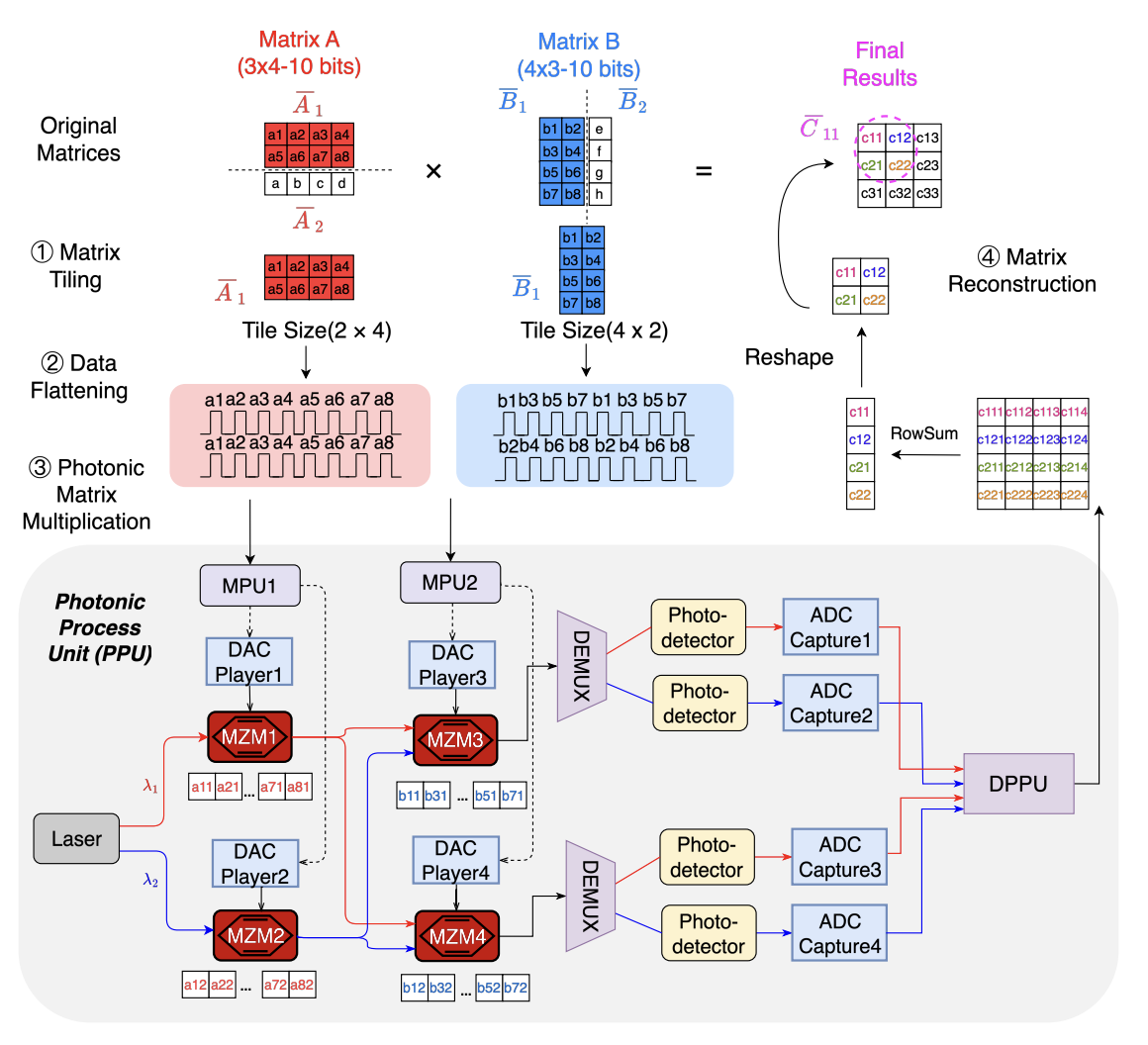
LightMat-HP: A Photonic-Electronic System for Accelerating General Matrix Multiplication With Configurable Precision
Hailong Gong, Haibo Zhang, Amanda S. Barnard, Mahbub Hassan, Matt Woolley, Rajkumar Buyya
Under review. 2026 arxiv Journal
Matrix multiplication is a fundamental kernel in large-scale artificial intelligence and scientific computing, but its performance on conventional electronic accelerators is increasingly constrained by memory bandwidth and energy efficiency. Photonic computing offers a promising alternative due to its ultra-high bandwidth, massive parallelism, and low power dissipation. However, most existing photonic systems are limited to low-precision computation because of analog optical modulation constraints and noise accumulation, which restricts their applicability in precision-critical workloads. To address this limitation, we propose LightMat-HP, a hybrid photonic-electronic computing system that enables end-to-end acceleration of general matrix multiplication with configurable computational precision. LightMat-HP adopts...
LightMat-HP: A Photonic-Electronic System for Accelerating General Matrix Multiplication With Configurable Precision
Hailong Gong, Haibo Zhang, Amanda S. Barnard, Mahbub Hassan, Matt Woolley, Rajkumar Buyya
Under review. 2026 arxiv Journal
Matrix multiplication is a fundamental kernel in large-scale artificial intelligence and scientific computing, but its performance on conventional electronic accelerators is increasingly constrained by memory bandwidth and energy efficiency. Photonic computing offers a promising alternative due to its ultra-high bandwidth, massive parallelism, and low power dissipation. However, most existing photonic systems are limited to low-precision computation because of analog optical modulation constraints and noise accumulation, which restricts their applicability in precision-critical workloads. To address this limitation, we propose LightMat-HP, a hybrid photonic-electronic computing system that enables end-to-end acceleration of general matrix multiplication with configurable computational precision. LightMat-HP adopts...
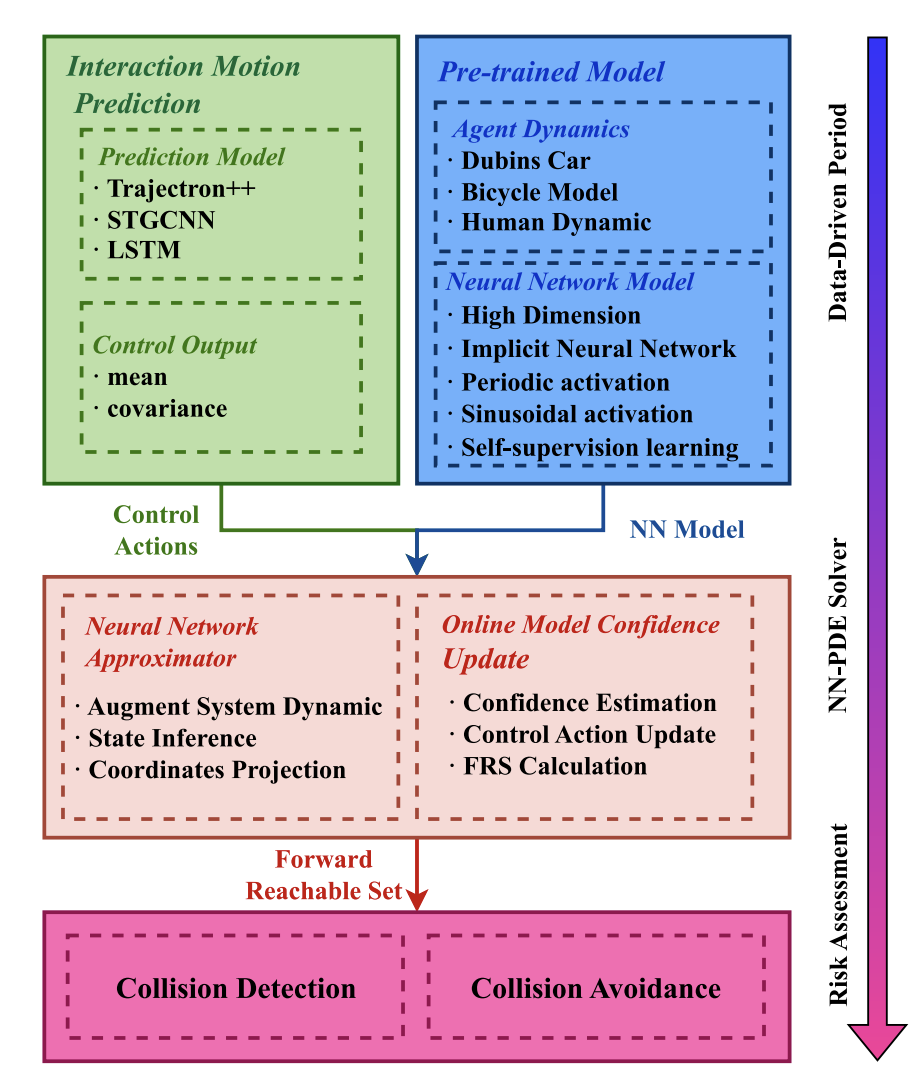
Towards Online Risk Assessment for Human-Robot Interaction: A Data-Driven Hamilton-Jacobi-Isaacs Reachability Approach
Hailong Gong*, Zirui Li*, Chao Lu, Jianwei Gong (* equal contribution)
International Conference on Intelligent Transportation Systems (ITSC) 2023 Conference
This paper introduces a novel online data-driven methodology for risk assessment in human-robot interaction scenarios. Traditional risk assessment techniques relying on the Hamilton-Jacobi-Isaacs (HJI) method are computationally intensive and require offline calculations. To overcome these limitations, the proposed approach leverages neural networks to predict control actions and construct an augmented dynamic model. The model then utilizes the HJI method to predict the Forward Reachable Set (FRS) for risk assessment. This approach addresses the challenges…
Towards Online Risk Assessment for Human-Robot Interaction: A Data-Driven Hamilton-Jacobi-Isaacs Reachability Approach
Hailong Gong*, Zirui Li*, Chao Lu, Jianwei Gong (* equal contribution)
International Conference on Intelligent Transportation Systems (ITSC) 2023 Conference
This paper introduces a novel online data-driven methodology for risk assessment in human-robot interaction scenarios. Traditional risk assessment techniques relying on the Hamilton-Jacobi-Isaacs (HJI) method are computationally intensive and require offline calculations. To overcome these limitations, the proposed approach leverages neural networks to predict control actions and construct an augmented dynamic model. The model then utilizes the HJI method to predict the Forward Reachable Set (FRS) for risk assessment. This approach addresses the challenges…
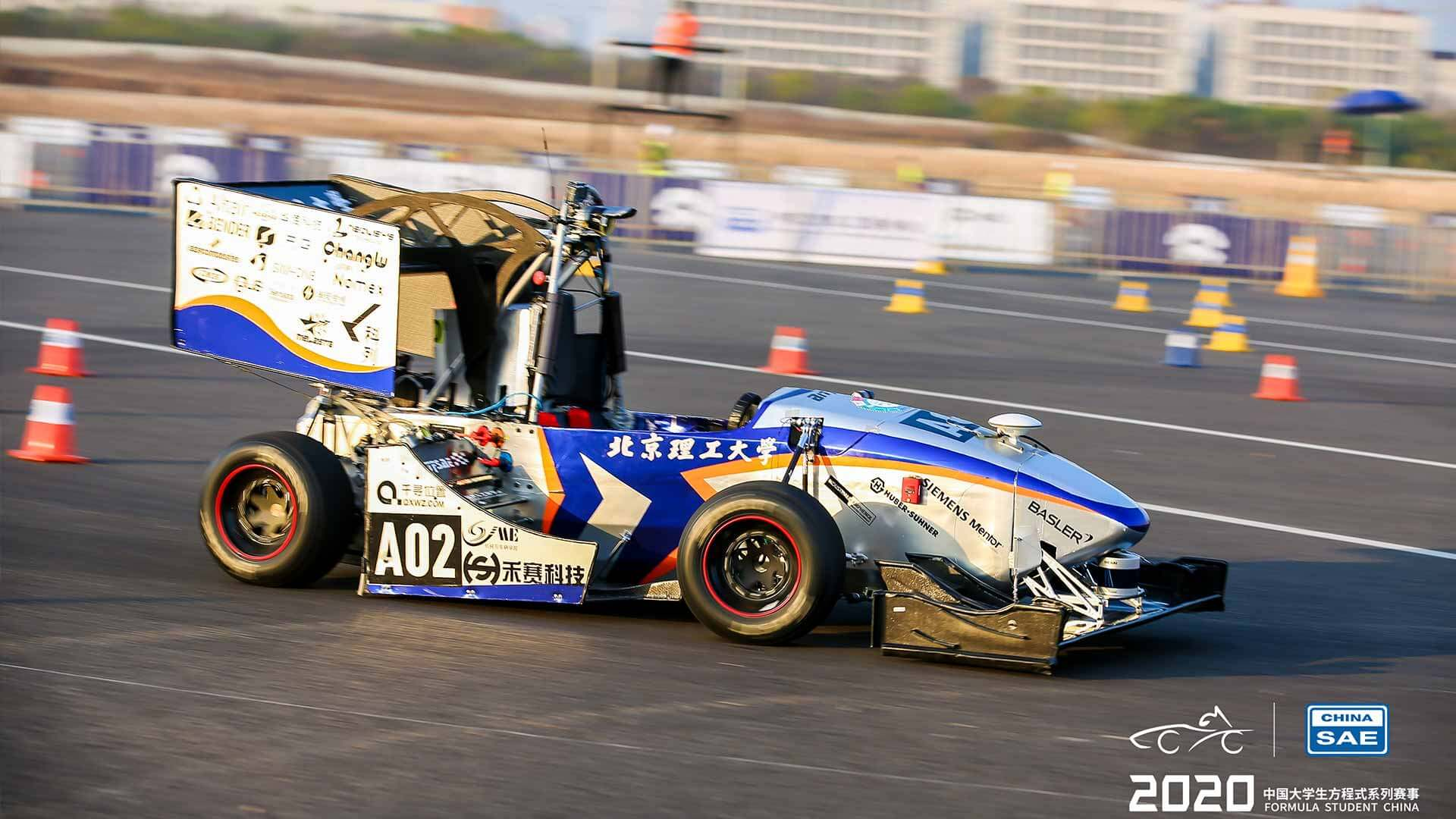
Fast and accurate: the perception system of a formula student driverless car
Hailong Gong*, Yunji Feng*, Tairan Chen*, Zuoou Li, Yunwei Li (* equal contribution)
International Conference on Robotics, Control and Automation (ICRCA) 2022 Conference
To detect the cone of the Formula Student Autonomous China (FSAC) track quickly and accurately, this paper proposed a fast and accurate perception system that fused the 3D LIDAR point cloud data and visual information. First, the vision part spliced the images of the two monocular cameras vertically and adopted the YOLOv3 target detection network with the attention mechanism to obtain the type of candidate targets and their position on the pixel plane. Afterward, the track boundary could be extracted and the drivable area could be segmented using cubic polynomial regression by the center of the bounding box. The LIDAR pipeline used the GPF algorithm and the Euclidean clustering algorithm to process the original point cloud to obtain the three-dimensional information of the cones’ coordinates. Finally, the 3D LIDAR point cloud data of reconstructed cones was projected onto the two-dimensional pixel plane …
Fast and accurate: the perception system of a formula student driverless car
Hailong Gong*, Yunji Feng*, Tairan Chen*, Zuoou Li, Yunwei Li (* equal contribution)
International Conference on Robotics, Control and Automation (ICRCA) 2022 Conference
To detect the cone of the Formula Student Autonomous China (FSAC) track quickly and accurately, this paper proposed a fast and accurate perception system that fused the 3D LIDAR point cloud data and visual information. First, the vision part spliced the images of the two monocular cameras vertically and adopted the YOLOv3 target detection network with the attention mechanism to obtain the type of candidate targets and their position on the pixel plane. Afterward, the track boundary could be extracted and the drivable area could be segmented using cubic polynomial regression by the center of the bounding box. The LIDAR pipeline used the GPF algorithm and the Euclidean clustering algorithm to process the original point cloud to obtain the three-dimensional information of the cones’ coordinates. Finally, the 3D LIDAR point cloud data of reconstructed cones was projected onto the two-dimensional pixel plane …