General Principles for Optimizing Processor Bottlenecks
General Principles for Optimizing Processor Bottlenecks
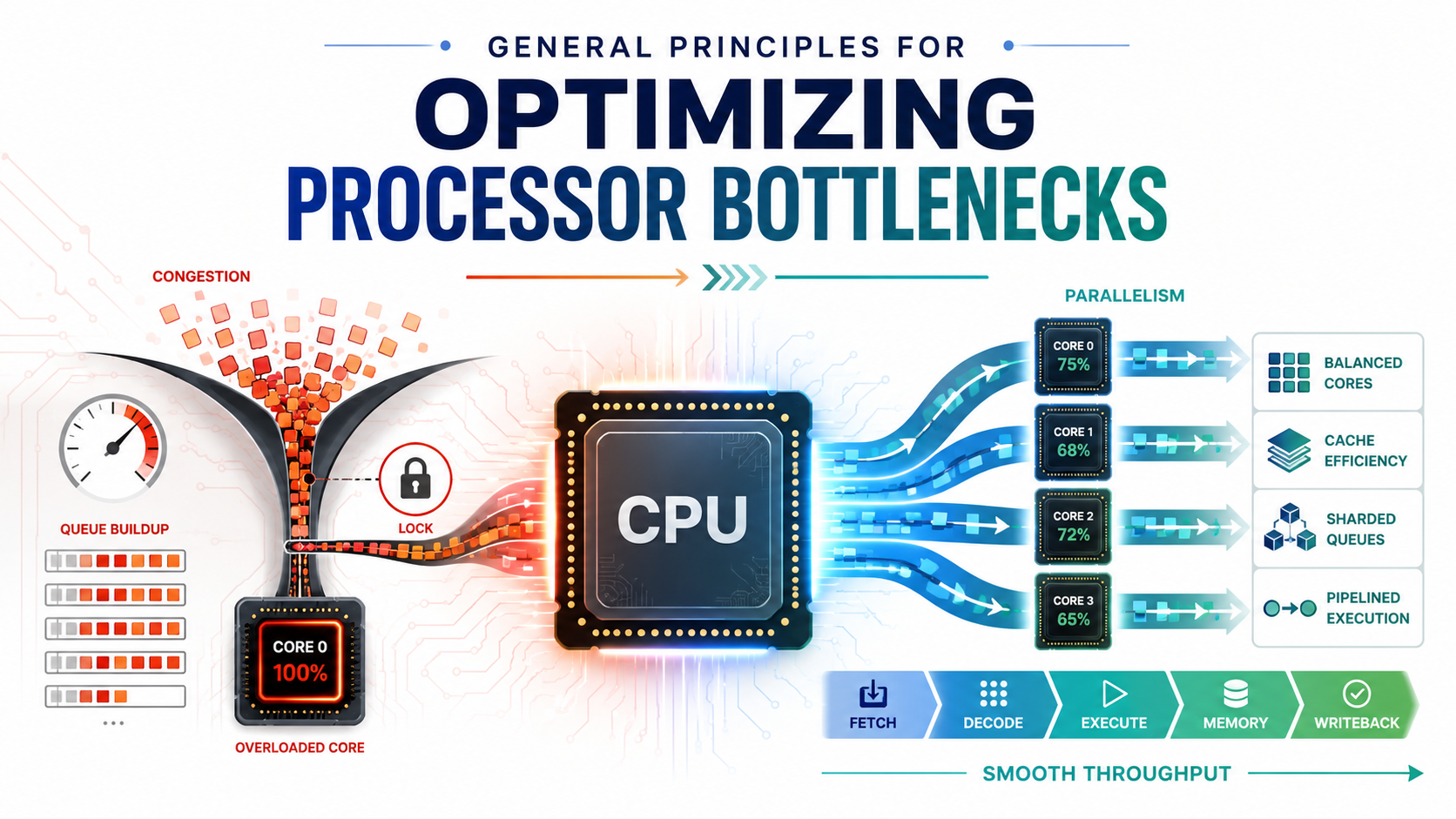
In computer systems, we often describe a component as a “bottleneck” when its utilization is high, the program becomes slower, or the system throughput can no longer scale. For example, a CPU core may stay at 100% utilization, a request queue may keep growing, or the response latency may increase significantly under load.
However, from an architectural perspective, high utilization does not necessarily indicate a real bottleneck. A processor can be busy without blocking the progress of the whole system. Conversely, a small serial step that consumes only a modest amount of CPU time may dominate end-to-end latency if every task has to wait for it.
A useful principle is:
Do not optimize what is merely busy. Optimize what blocks progress.
This post summarizes several general principles for analyzing processor bottlenecks and choosing appropriate optimization strategies.
1. Start from First Principles
The execution time of a computational task can be roughly expressed as:
T = work amount × cost per operation
In other words, the total execution time is determined by how much work needs to be done and how expensive each operation is.
Therefore, most performance optimizations can be grouped into several basic categories:
- Reduce the amount of work.
- Reduce the cost of each operation.
- Increase parallelism.
- Hide unavoidable latency.
- Improve data locality.
- Move the task to a more suitable execution substrate or system layer.
The real challenge is not knowing these techniques, but understanding which one matches the bottleneck at hand.
2. A Busy CPU Is Not Necessarily Blocking the System
When analyzing a bottleneck, the first question should be:
Is the CPU work on the critical path?
If a processor is highly utilized but the main task can still make steady progress, the issue may only be a resource efficiency problem. In this case, adding more CPU cores, pinning threads, reducing background tasks, or rewriting hot paths with lower-overhead implementations may be sufficient.
However, if a CPU-side operation delays the following execution stages, causes tasks to wait, builds up queues, or increases end-to-end latency, it becomes a critical-path bottleneck. This type of bottleneck should be optimized first because it directly limits system progress.
In practice, we can think of the total time as:
T_{\text{total}} = T_{\text{overlapped}} + T_{\text{blocked}}
The most important part to optimize is often not the total CPU time, but the portion that cannot be overlapped and truly blocks system progress.
3. Reduce Work Before Adding Compute
If the bottleneck comes from doing too much unnecessary work, the best optimization is to avoid doing that work in the first place.
Common approaches include caching intermediate results, reusing metadata, removing redundant checks, avoiding repeated computation, and merging multiple small tasks into a larger execution unit.
This principle is simple but important:
The fastest operation is the one that is never executed.
Before designing a faster implementation, we should first ask whether the operation really needs to be performed every time.
4. Reduce the Cost of Frequent Operations
Some bottlenecks do not come from a single expensive operation, but from a tiny operation that is executed too many times. Even if each operation takes only a small amount of time, the accumulated overhead can become significant.
Typical examples include frequent memory allocation, object construction, system calls, lock contention, function dispatch, and interpreter overhead.
Possible optimizations include using preallocated buffers, memory pools, compact data structures, batched system calls, fewer abstraction layers, and moving hot paths from interpreted languages to native implementations such as C, C++, or Rust.
The key question is:
What is the cost per operation, and how many times is this cost paid?
A small overhead on a cold path is usually unimportant. A small overhead on a hot path may dominate the overall performance.
5. Remove Serial Bottlenecks
A common symptom of a serial bottleneck is that one CPU core is fully utilized while other cores remain idle. This often indicates a centralized component, such as a global queue, a single-threaded scheduler, a global lock, or a single-threaded preprocessing stage.
Possible solutions include splitting global state, introducing worker pools, using per-core or per-thread queues, removing global locks, and replacing centralized data structures with distributed ones.
The goal is to avoid this pattern:
one busy core + many idle cores
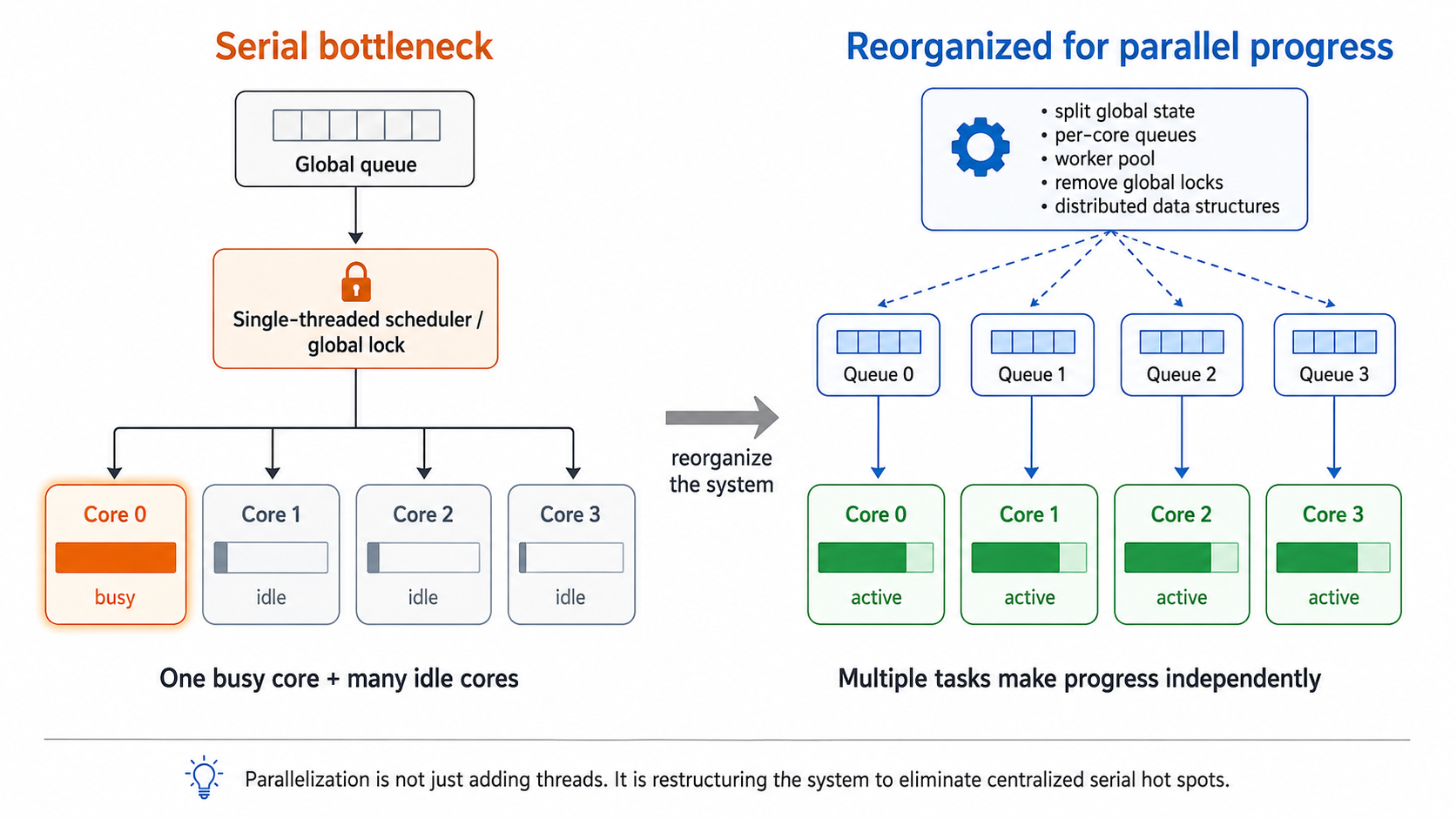
Parallelization is not just about adding more threads. It requires reorganizing the system so that multiple tasks can make progress independently.
6. Optimize Data Locality
Many processor bottlenecks are not caused by arithmetic computation, but by memory access.
A program may have relatively low CPU utilization and still run slowly because of cache misses, pointer chasing, random memory accesses, or remote NUMA accesses.
Common optimizations include replacing linked lists and scattered objects with contiguous arrays, reducing pointer indirection, grouping frequently accessed fields together, using compact representations, prefetching data, avoiding false sharing, and placing data closer to the CPU cores that use it.
A useful principle is:
Bring data closer to computation, and make access patterns more predictable.
Modern processors are fast, but they often spend a large amount of time waiting for data.
7. Hide Unavoidable Latency
Not all latency can be removed. Memory accesses, I/O, synchronization, and remote communication are often unavoidable. In such cases, the goal is not to eliminate the latency completely, but to hide it behind other useful work.
Common techniques include pipelining, asynchronous execution, prefetching, double buffering, producer-consumer queues, and preparing future work while the current task is executing.
The original execution may look like:
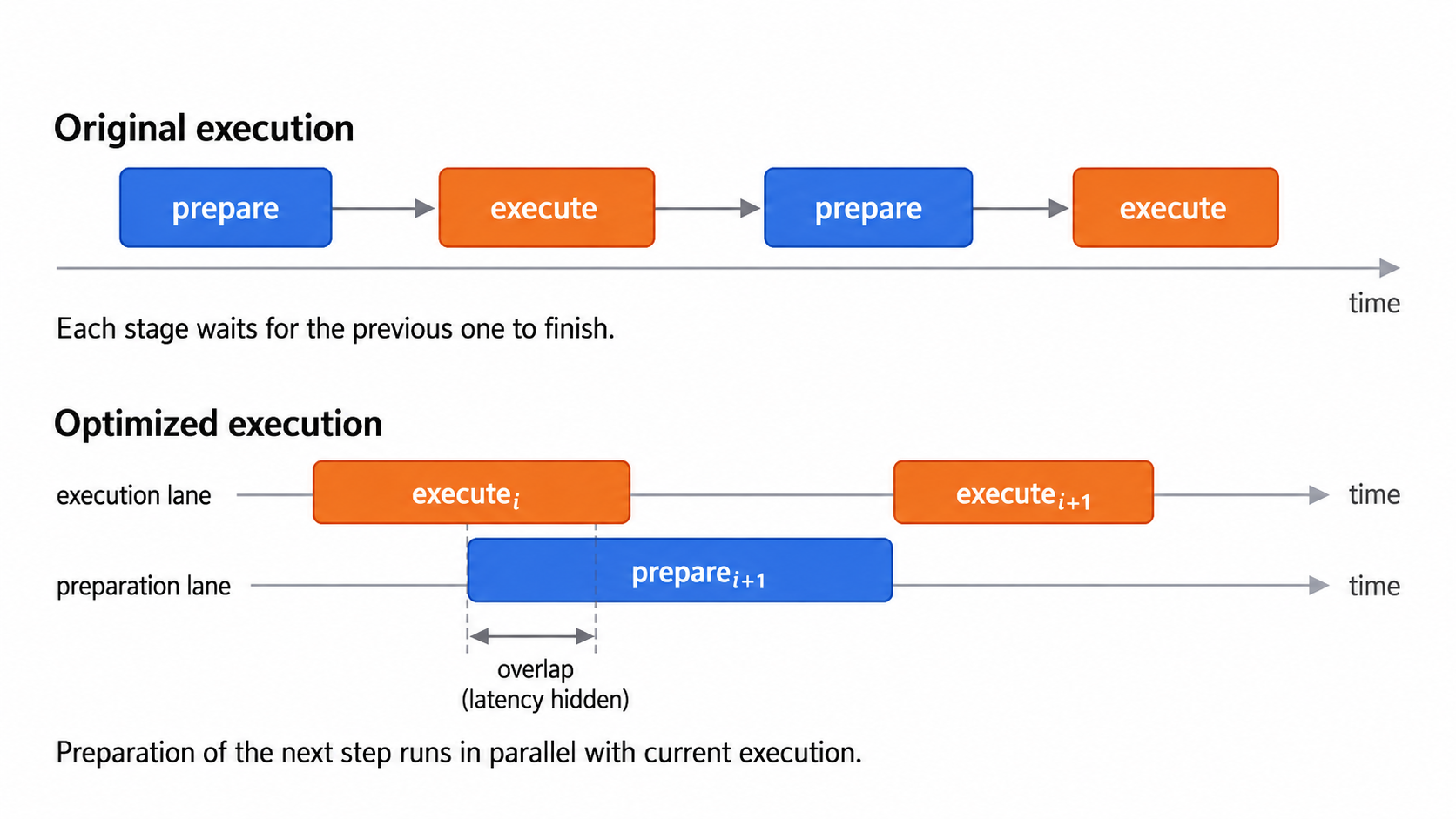
If latency can be covered by other useful work, it will not fully appear in the end-to-end execution time.
8. Amortize High-Frequency Control Overheads
Some overheads are small individually but occur very frequently. For example, a system may perform scheduling, bookkeeping, synchronization, or metadata updates for every tiny unit of work.
In this case, the optimization goal is to reduce how often the system enters the hot path.
Common approaches include batching, multi-step execution, merging state updates, bulk memory allocation, and using one decision to cover multiple future operations.
The core idea is:
many small overheads ---> one amortized overhead
Amortization becomes especially important when the control overhead is more expensive than the useful work itself.
9. Use Specialization Carefully
Hardware or architectural specialization can provide significant benefits, but it is usually not the first option to consider, as it requires additional design and engineering effort.
A task is a good candidate for specialization when it satisfies several conditions:
- It is executed frequently.
- Its behavior is stable and well understood.
- It lies on the critical path.
- It cannot be fully hidden through overlap.
- It has a measurable impact on end-to-end performance.
Specialization can take the form of custom instructions, hardware accelerators, coprocessors, near-data processing, or redesigned software-hardware interfaces.
It becomes most convincing when profiling shows that a fixed, repeated, critical-path operation remains expensive even after software optimization.
10. A Simple Optimization Decision Table
| Observation | Possible Cause | Preferred Optimization Strategy |
|---|---|---|
| CPU is busy, but the system is not slow | Resource efficiency issue | Core pinning, resource provisioning, native implementation |
| A CPU step delays the main task | Critical-path bottleneck | Overlap, reduce frequency, offload |
| One core is saturated, but total CPU utilization is low | Serial bottleneck | Sharding, parallelization, removing global locks |
| CPU utilization is low, but the program is slow | Poor data locality | Improve data layout, reduce cache misses |
| System calls are very frequent | OS overhead | Batching, asynchronous I/O, zero-copy |
| More threads make performance worse | Thread oversubscription | Thread budgeting, fewer workers, core isolation |
| A small overhead repeats many times | High-frequency control overhead | Batching, amortization, multi-step execution |
| Software optimization is still insufficient | Stable critical hot path | Specialization or hardware acceleration |
Conclusion
Processor optimization is not about making every part of the system faster. It is about understanding which part truly limits system progress.
A busy component is not always worth optimizing first. A seemingly small operation should not always be ignored. The most important bottleneck is the one that blocks the critical path.
In short:
Do not optimize what is merely busy. Optimize what blocks progress.