Conference Deadlines Tracker
A live countdown for the key venues in FPGA & computer architecture — FPGA, FPT, FPL, FCCM, ISCA, MICRO, DAC, ASPLOS and more.
Publications
2026
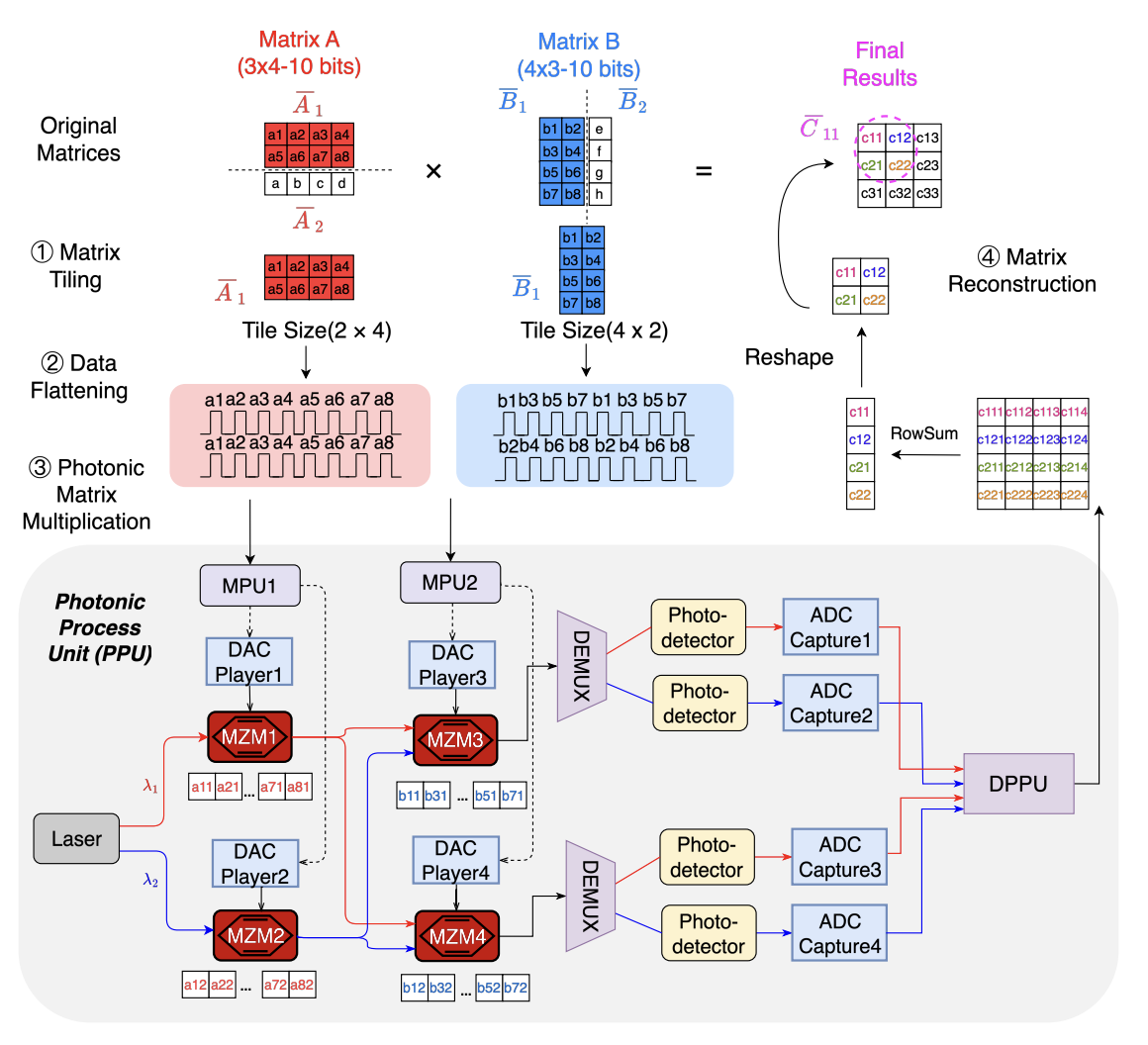
LightMat-HP: A Photonic-Electronic System for Accelerating General Matrix Multiplication With Configurable Precision
Hailong Gong, Haibo Zhang, Amanda S. Barnard, Mahbub Hassan, Matt Woolley, Rajkumar Buyya
Under review. 2026 arxiv Journal
Matrix multiplication is a fundamental kernel in large-scale artificial intelligence and scientific computing, but its performance on conventional electronic accelerators is increasingly constrained by memory bandwidth and energy efficiency. Photonic computing offers a promising alternative due to its ultra-high bandwidth, massive parallelism, and low power dissipation. However, most existing photonic systems are limited to low-precision computation because of analog optical modulation constraints and noise accumulation, which restricts their applicability in precision-critical workloads. To address this limitation, we propose LightMat-HP, a hybrid photonic-electronic computing system that enables end-to-end acceleration of general matrix multiplication with configurable computational precision. LightMat-HP adopts...
LightMat-HP: A Photonic-Electronic System for Accelerating General Matrix Multiplication With Configurable Precision
Hailong Gong, Haibo Zhang, Amanda S. Barnard, Mahbub Hassan, Matt Woolley, Rajkumar Buyya
Under review. 2026 arxiv Journal
Matrix multiplication is a fundamental kernel in large-scale artificial intelligence and scientific computing, but its performance on conventional electronic accelerators is increasingly constrained by memory bandwidth and energy efficiency. Photonic computing offers a promising alternative due to its ultra-high bandwidth, massive parallelism, and low power dissipation. However, most existing photonic systems are limited to low-precision computation because of analog optical modulation constraints and noise accumulation, which restricts their applicability in precision-critical workloads. To address this limitation, we propose LightMat-HP, a hybrid photonic-electronic computing system that enables end-to-end acceleration of general matrix multiplication with configurable computational precision. LightMat-HP adopts...
2025

A paper about Photonic Computing
Submitted. 2025 Conference Under review
A paper about Photonic Computing
Submitted. 2025 Conference Under review
2023
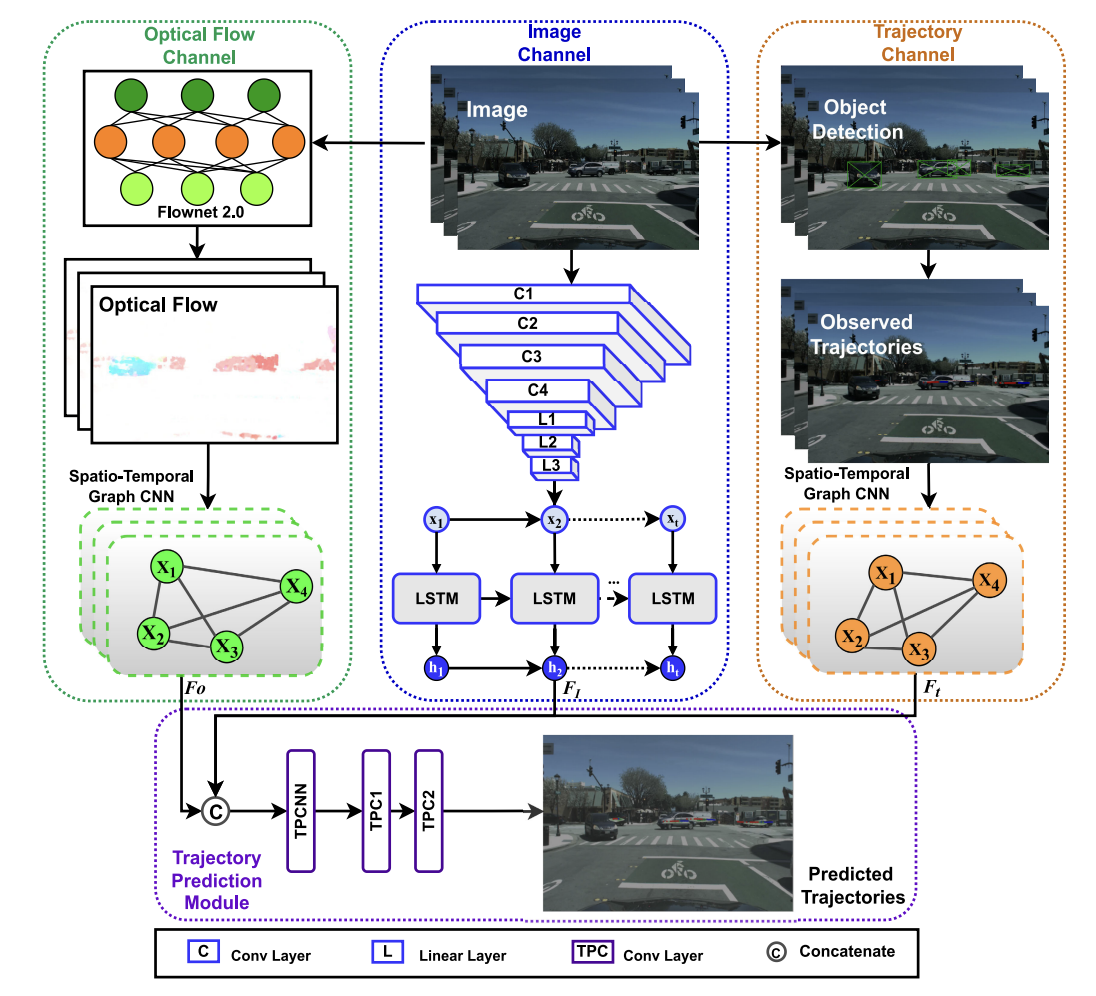
Leveraging multi-stream information fusion for trajectory prediction in low-illumination scenarios: A multi-channel graph convolutional approach
Hailong Gong*, Zirui Li*, Chao Lu, Guodong Du, Jianwei Gong (* equal contribution)
IEEE Transactions on Intelligent Transportation Systems 2023 Journal
Trajectory prediction is a fundamental problem and challenge for autonomous vehicles. Early works mainly focused on designing complicated architectures for deep-learning-based prediction models in normal-illumination environments, which fail in dealing with low-light conditions. The paper proposes a novel approach for trajectory prediction in low-illumination scenarios by leveraging multi-stream information fusion, which integrates image, optical flow, and object trajectory information. This is achieved by applying Convolutional Neural Network-based (CNN) Long Short-term Memory (LSTM) networks to extract temporal information from the image channel, Spatial-Temporal Graph Convolutional Network (ST-GCN) to model relative motion between adjacent camera frames through the optical flow channel, and recognizing high-level interactions between vehicles in the trajectory channel...
Leveraging multi-stream information fusion for trajectory prediction in low-illumination scenarios: A multi-channel graph convolutional approach
Hailong Gong*, Zirui Li*, Chao Lu, Guodong Du, Jianwei Gong (* equal contribution)
IEEE Transactions on Intelligent Transportation Systems 2023 Journal
Trajectory prediction is a fundamental problem and challenge for autonomous vehicles. Early works mainly focused on designing complicated architectures for deep-learning-based prediction models in normal-illumination environments, which fail in dealing with low-light conditions. The paper proposes a novel approach for trajectory prediction in low-illumination scenarios by leveraging multi-stream information fusion, which integrates image, optical flow, and object trajectory information. This is achieved by applying Convolutional Neural Network-based (CNN) Long Short-term Memory (LSTM) networks to extract temporal information from the image channel, Spatial-Temporal Graph Convolutional Network (ST-GCN) to model relative motion between adjacent camera frames through the optical flow channel, and recognizing high-level interactions between vehicles in the trajectory channel...
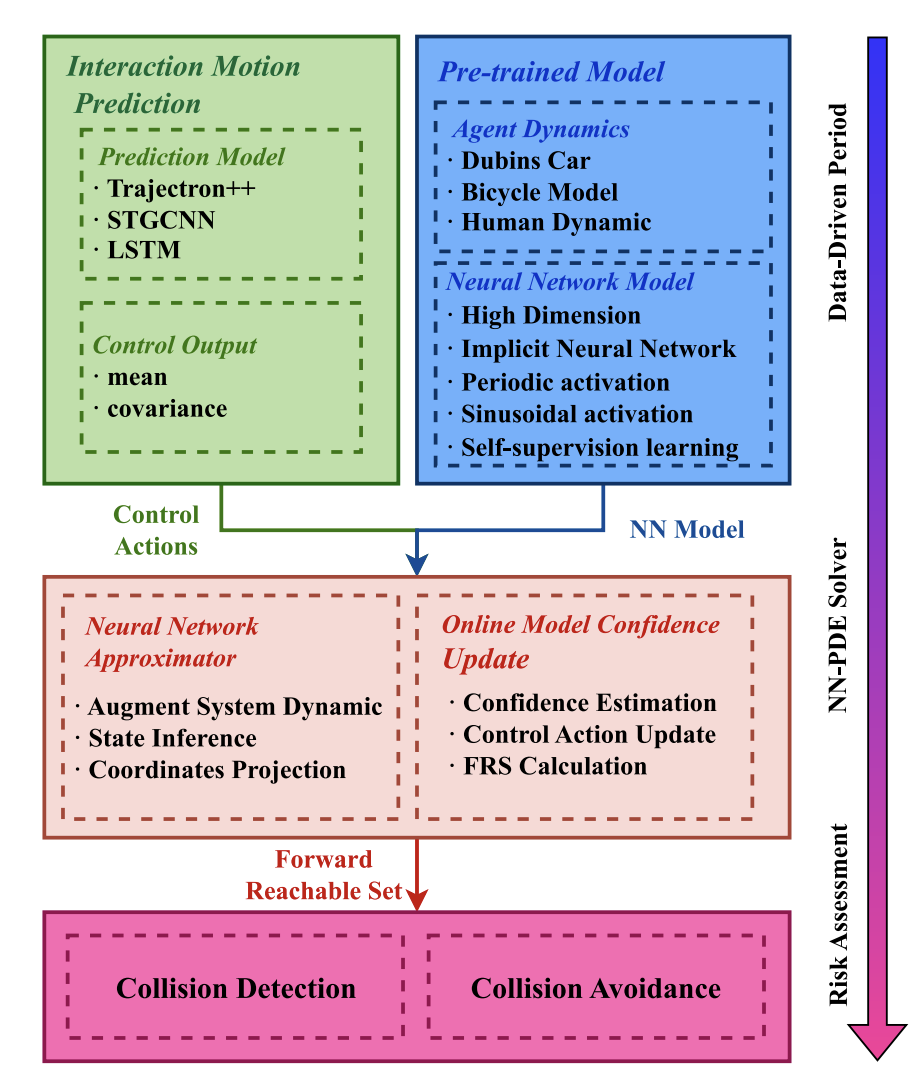
Towards Online Risk Assessment for Human-Robot Interaction: A Data-Driven Hamilton-Jacobi-Isaacs Reachability Approach
Hailong Gong*, Zirui Li*, Chao Lu, Jianwei Gong (* equal contribution)
International Conference on Intelligent Transportation Systems (ITSC) 2023 Conference
This paper introduces a novel online data-driven methodology for risk assessment in human-robot interaction scenarios. Traditional risk assessment techniques relying on the Hamilton-Jacobi-Isaacs (HJI) method are computationally intensive and require offline calculations. To overcome these limitations, the proposed approach leverages neural networks to predict control actions and construct an augmented dynamic model. The model then utilizes the HJI method to predict the Forward Reachable Set (FRS) for risk assessment. This approach addresses the challenges…
Towards Online Risk Assessment for Human-Robot Interaction: A Data-Driven Hamilton-Jacobi-Isaacs Reachability Approach
Hailong Gong*, Zirui Li*, Chao Lu, Jianwei Gong (* equal contribution)
International Conference on Intelligent Transportation Systems (ITSC) 2023 Conference
This paper introduces a novel online data-driven methodology for risk assessment in human-robot interaction scenarios. Traditional risk assessment techniques relying on the Hamilton-Jacobi-Isaacs (HJI) method are computationally intensive and require offline calculations. To overcome these limitations, the proposed approach leverages neural networks to predict control actions and construct an augmented dynamic model. The model then utilizes the HJI method to predict the Forward Reachable Set (FRS) for risk assessment. This approach addresses the challenges…
2022
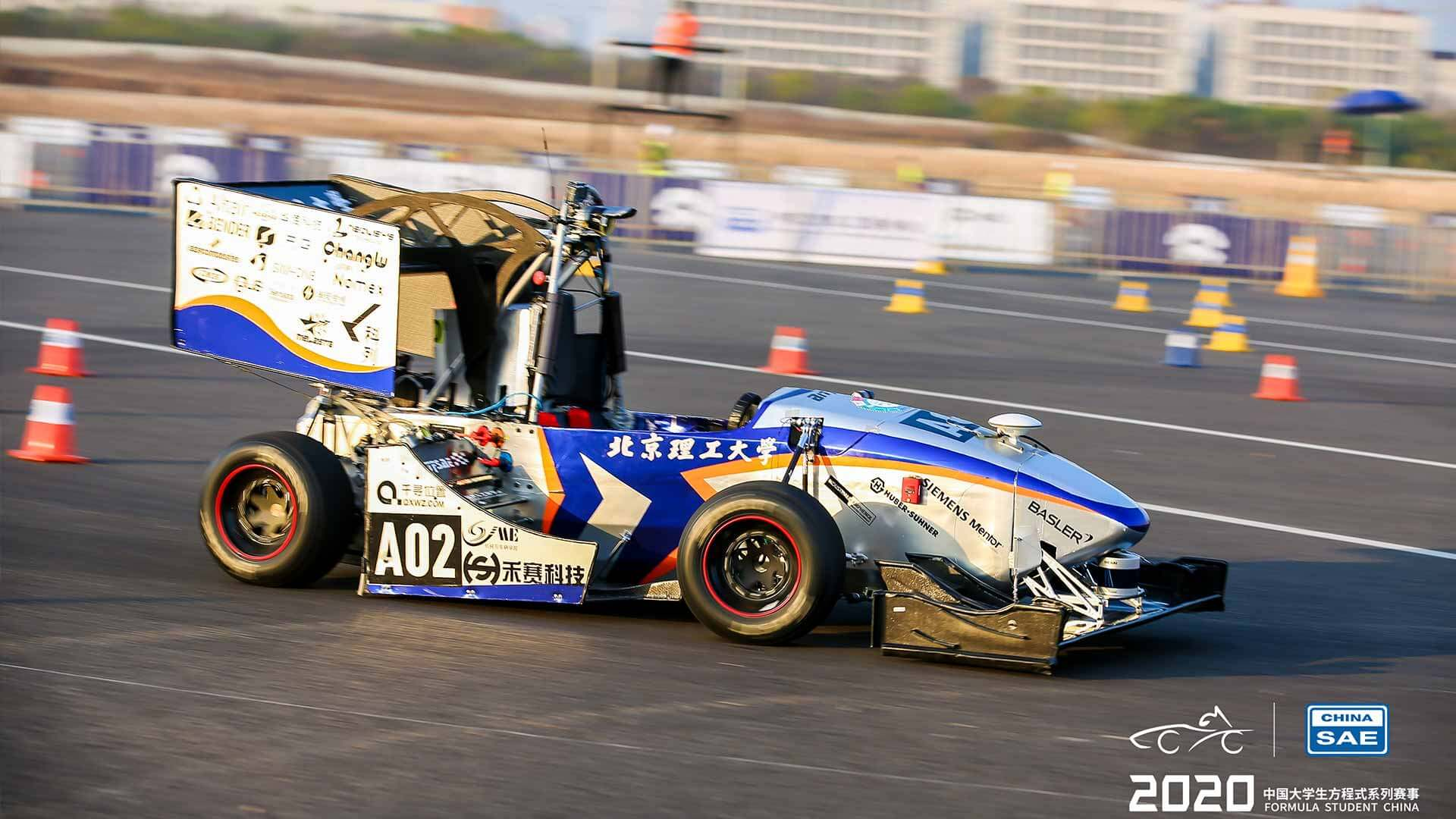
Fast and accurate: the perception system of a formula student driverless car
Hailong Gong*, Yunji Feng*, Tairan Chen*, Zuoou Li, Yunwei Li (* equal contribution)
International Conference on Robotics, Control and Automation (ICRCA) 2022 Conference
To detect the cone of the Formula Student Autonomous China (FSAC) track quickly and accurately, this paper proposed a fast and accurate perception system that fused the 3D LIDAR point cloud data and visual information. First, the vision part spliced the images of the two monocular cameras vertically and adopted the YOLOv3 target detection network with the attention mechanism to obtain the type of candidate targets and their position on the pixel plane. Afterward, the track boundary could be extracted and the drivable area could be segmented using cubic polynomial regression by the center of the bounding box. The LIDAR pipeline used the GPF algorithm and the Euclidean clustering algorithm to process the original point cloud to obtain the three-dimensional information of the cones’ coordinates. Finally, the 3D LIDAR point cloud data of reconstructed cones was projected onto the two-dimensional pixel plane …
Fast and accurate: the perception system of a formula student driverless car
Hailong Gong*, Yunji Feng*, Tairan Chen*, Zuoou Li, Yunwei Li (* equal contribution)
International Conference on Robotics, Control and Automation (ICRCA) 2022 Conference
To detect the cone of the Formula Student Autonomous China (FSAC) track quickly and accurately, this paper proposed a fast and accurate perception system that fused the 3D LIDAR point cloud data and visual information. First, the vision part spliced the images of the two monocular cameras vertically and adopted the YOLOv3 target detection network with the attention mechanism to obtain the type of candidate targets and their position on the pixel plane. Afterward, the track boundary could be extracted and the drivable area could be segmented using cubic polynomial regression by the center of the bounding box. The LIDAR pipeline used the GPF algorithm and the Euclidean clustering algorithm to process the original point cloud to obtain the three-dimensional information of the cones’ coordinates. Finally, the 3D LIDAR point cloud data of reconstructed cones was projected onto the two-dimensional pixel plane …
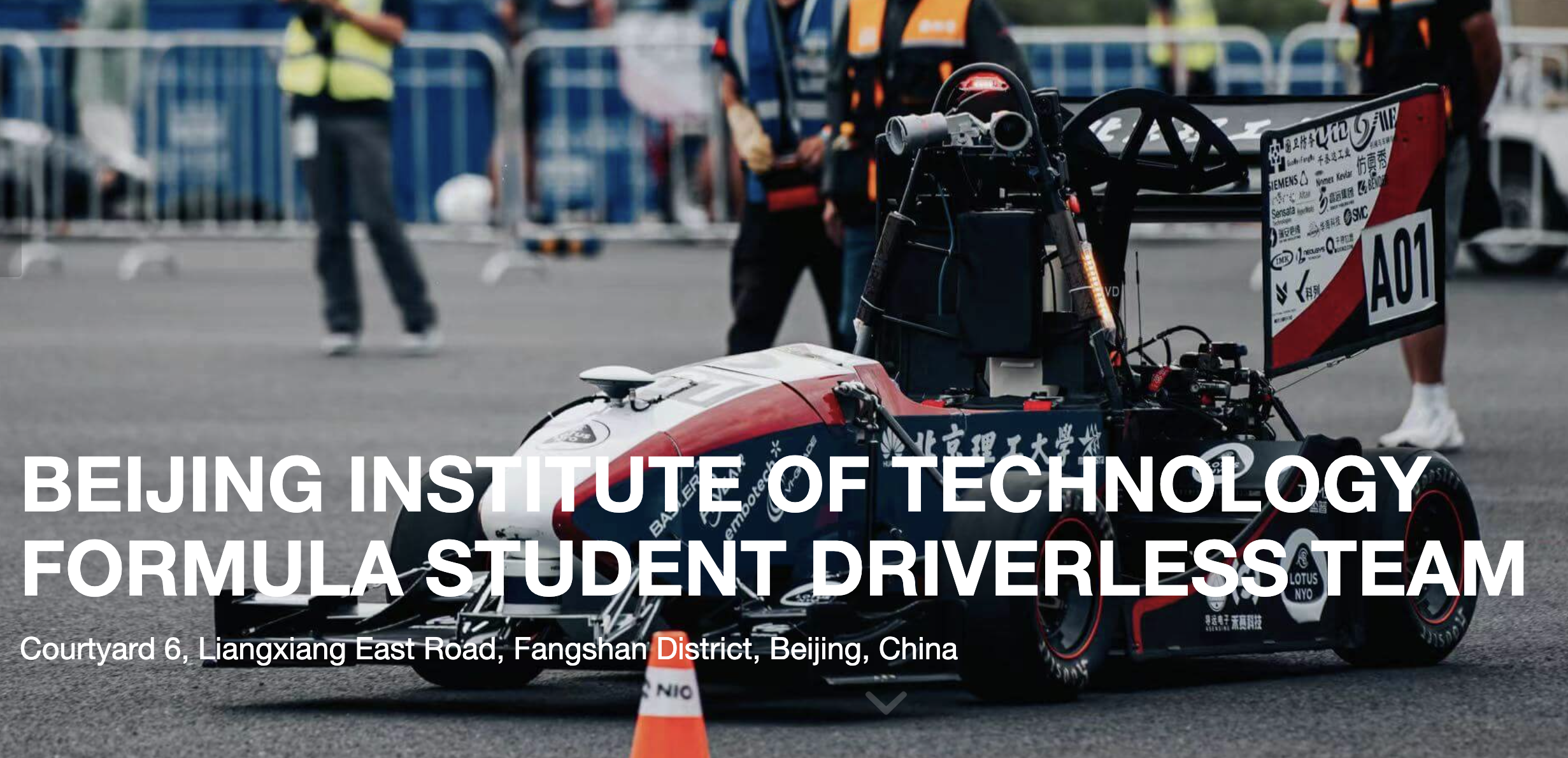
Real-Time Motion Planning and Control for a Formula Student Driverless Car
Tairan Chen, Xinyu Gao, Chenrui Huang, Xiang Li, Shaokun Yang, Hailong Gong, Yunji Feng
Proceedings of China SAE Congress 2020: Selected Papers 2022
This paper presents a planning and control pipeline for an autonomous race car to drive around a track that may not be previously known for three laps. In the case of a limited perception range in the first lap, boundary detection and motion planning separately extract and optimize the trajectory to minimize the trajectory curvature. After finishing the mapping, multi-strategy NMPC is used to optimize or track the trajectory. We use the real-world map data from Formula Student Autonomous China 2019 for experiments. The experiment shows that under the same vehicle model, the system can significantly improve the performance of the race car.
Real-Time Motion Planning and Control for a Formula Student Driverless Car
Tairan Chen, Xinyu Gao, Chenrui Huang, Xiang Li, Shaokun Yang, Hailong Gong, Yunji Feng
Proceedings of China SAE Congress 2020: Selected Papers 2022
This paper presents a planning and control pipeline for an autonomous race car to drive around a track that may not be previously known for three laps. In the case of a limited perception range in the first lap, boundary detection and motion planning separately extract and optimize the trajectory to minimize the trajectory curvature. After finishing the mapping, multi-strategy NMPC is used to optimize or track the trajectory. We use the real-world map data from Formula Student Autonomous China 2019 for experiments. The experiment shows that under the same vehicle model, the system can significantly improve the performance of the race car.